
Renovating or Repositioning a Restaurant or Bar
An established venue already has guests, a team and a trading record, so BDS works out what the business needs before deciding what the room needs.
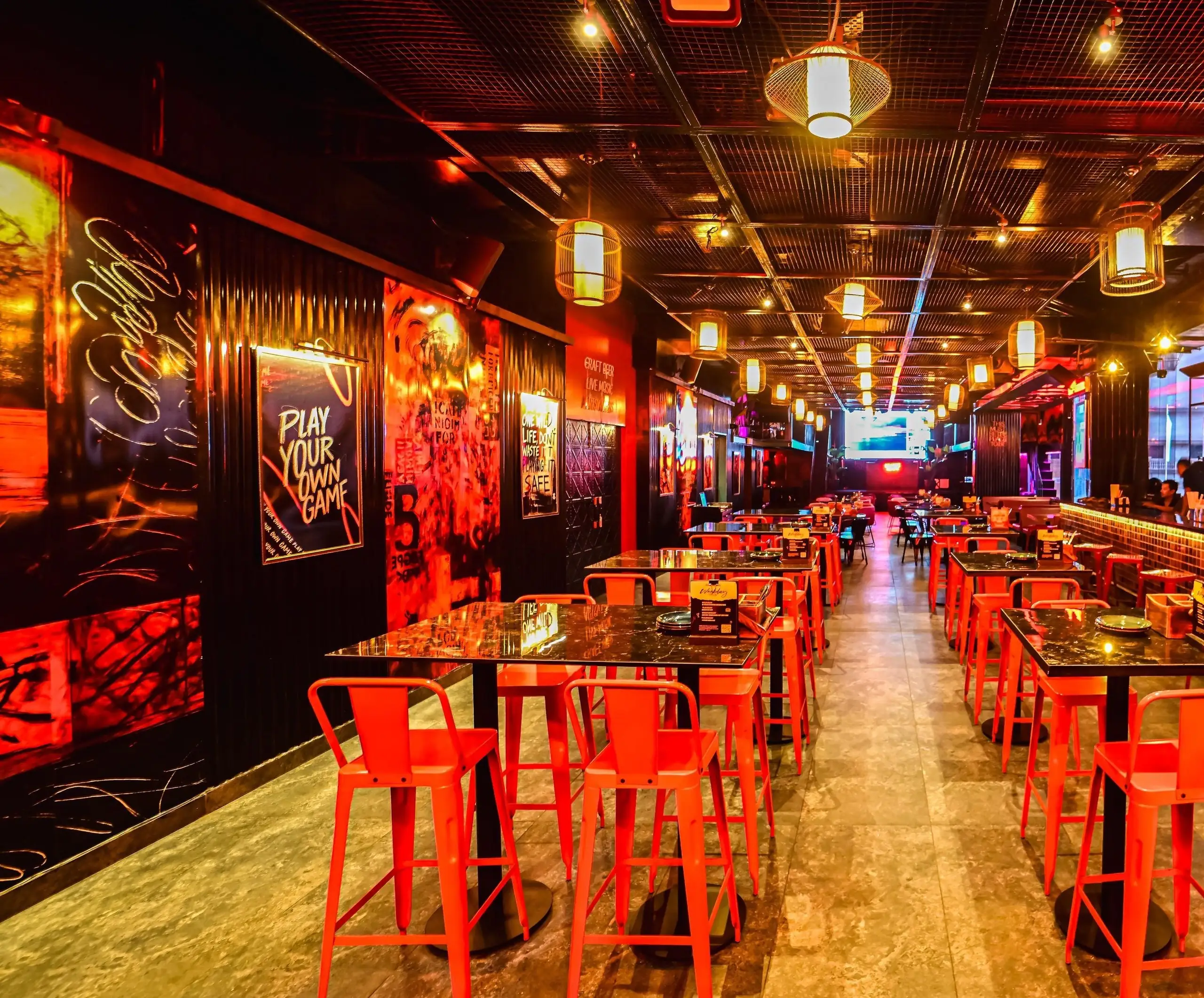
Nuts & Brew, Guwahati · BDS repositioning, 2025
Owners often come to a renovation sensing that the venue has fallen behind: the room looks tired, newer places have opened nearby, certain nights have gone quiet. The instinct is to redo the interior. Sometimes that is right. But the room may be only the most visible part of a problem that also sits in the menu, the bar or how guests understand the venue.
An existing business has something a new one does not: evidence. Sales by day and hour, dishes that sell and dishes that do not, reviews, and regulars who still come for something. BDS starts there, and the evidence decides whether the job is a refresh, a renovation or a repositioning.
Refresh, renovate or reposition
The words are often used interchangeably, but they describe three different projects, with different costs and risks.
- A refresh keeps the concept and the customer, and updates what guests see and touch: finishes, lighting, furniture, menus and uniforms. It suits a business that still trades well in a room that has aged.
- A renovation changes the building: the layout, the seating, the bar, the kitchen or the services behind them. It suits a concept that still works in a space that is working against it.
- A repositioning changes the business: who the venue is for, what it offers and at what price, with the room, the menu and the service moving together. It suits a venue whose offer has drifted away from the guests it needs.
Choosing the wrong one is expensive either way. A new room around an unchanged offer gives guests little new reason to visit. A full repositioning where a refresh would have done spends capital the business did not need to spend.
Diagnosis before design
Before anything is drawn, BDS looks at how the venue trades now:
- Sales by day and daypart: when the venue is full, and when it is not.
- The menu: which dishes and drinks sell, which earn, and which do neither.
- The bar: how the range, the stations and the pour hold up at the busiest hour.
- The floor: how the seating matches the way guests arrive, and how far service has to travel.
- The kitchen: whether it can produce the menu at the covers the room allows.
- Reviews and regulars: what guests praise, what they complain about, and what still brings people back.
A diagnosis should end in a written brief: what has to change, what should stay, and what the change has to achieve. What stays matters as much as what changes, because an established venue has goodwill worth keeping. Design starts from that brief, for the same reason a concept should come before its interior.
What can change
Once the brief is clear, the change can reach any part of the business. Each part affects the others, so they are planned together:
- Layout and covers: seating matched to how guests arrive, and shorter service routes.
- The bar: stations, storage, the back bar and, in a brewpub, the number of taps and how the range rotates.
- The menu: its length, its pricing and what it asks of the kitchen.
- The kitchen: equipment and stations matched to the menu, with the pass in the right place for the floor.
- The brand: name, identity, menus, uniforms and signage, so the new position is visible from the door.
- Service: how the team works the room, and the training that goes with every change.
Each of these draws on BDS’s expertise: restaurant design for the layout and kitchen, bars and microbreweries for the bar, food and beverage for the menu, brand and growth for the identity, and operations for service and training.
Trading through the works, or closing
Every renovation has to settle whether the venue keeps trading. Staying open protects income and keeps regulars in the habit of visiting, but the works must be phased around service and guests see the business mid-change. Closing makes the works faster and cleaner and allows a clear relaunch, but income stops and regulars have to be won back.
The answer depends on how much is changing and how much the business relies on its regulars. When the kitchen, the bar or the services behind them move, a planned closure is usually more practical; when the change is mostly surfaces and furniture, it can often be phased around trade. The phasing, any closure and what it means for staff and stock should be settled before work starts. A closure can also be put to use, training the team on the new menu and service while the room is finished.
Relaunch
A repositioned venue has to tell people it has changed. Regulars need to know that what they came for is still there, or better; new guests need a reason to try a venue they may already have made up their minds about. The relaunch is planned with the renovation, not after it: identity, menus and uniforms ready for the first day, trial services on the new offer, and photography that shows the venue as it now trades. It is judged by repeat visits, not opening-week reach.
In practice: Nuts & Brew, Guwahati
Nuts & Brew was already an established, trading microbrewery in Guwahati when BDS was brought in for its 2025 repositioning. The brief was to reposition the business for a new generation of guests, not only to renovate the room.
The interiors were renovated and modernised, and the food programme, the food and drinks menus and the staff uniforms were redesigned. In a brewery the tap list is the core of the offer, and the beer programme grew from four beers on tap to eight. The repositioned venue reopened in April 2025.
From the operator’s side
Rish Saini, Founder & Director of BDS, is also Founder & Director of Underdoggs, founded in 2011, and Director of Mrs Kaur’s Bakery & Cafe since 2009. Running venues long after they open is where the studio’s view of renovation comes from: whether a venue needs new paint, a new layout or a new idea is a question about the business before it is a question about the room.
BDS is an operator-led studio based in Gurgaon, working across Delhi NCR and India. To talk through a renovation, start a conversation with BDS or call +91 98187 00006.
Frequently asked questions
How do I know whether my restaurant needs a refresh or a repositioning?
Start with the trade, not the room. If the venue is still busy with the guests it was built for and the complaint is mainly that it looks tired, a refresh may be enough. If the right guests have stopped coming, new finishes alone are unlikely to bring them back. A diagnosis of sales, menu, reviews and layout usually makes the answer clear.
Can we keep trading during a renovation?
Often, if the work can be phased around service and the kitchen and services stay where they are. When the kitchen, the bar or the services behind them move, a planned closure is usually more practical. Either way, the options and the trade-offs are best set out before work starts.
Will a renovation cost us our regulars?
It can, if it removes what they came for. The diagnosis identifies what regulars value so the change can keep it, and the relaunch tells them what has stayed as well as what is new.
Do we have to change the name?
Not necessarily. A known name carries goodwill and is often worth keeping. A new name makes sense when the old one is tied to an offer the business is leaving behind.
We run a brewpub. Can BDS work on the beer programme as well as the room?
Yes. BDS plans the tap list, the bar and the room together. At Nuts & Brew in Guwahati, the 2025 repositioning expanded the beer programme from four beers on tap to eight, alongside new interiors, a redesigned food programme and new menus.
Three starting points
Renovating or repositioning is one of three starting points.
Opening a new venue
A new restaurant, bar, café or brewery, planned from the business outward before money goes into the fit-out.
Improving how a venue trades
A venue that is open but not trading as it should: the numbers first, then the menu, bar, room and service.
Building or transforming a hospitality business?
Whether starting with an idea, repositioning an existing restaurant or developing a scalable hospitality brand, begin with the business you want to build.
Or call +91 98187 00006