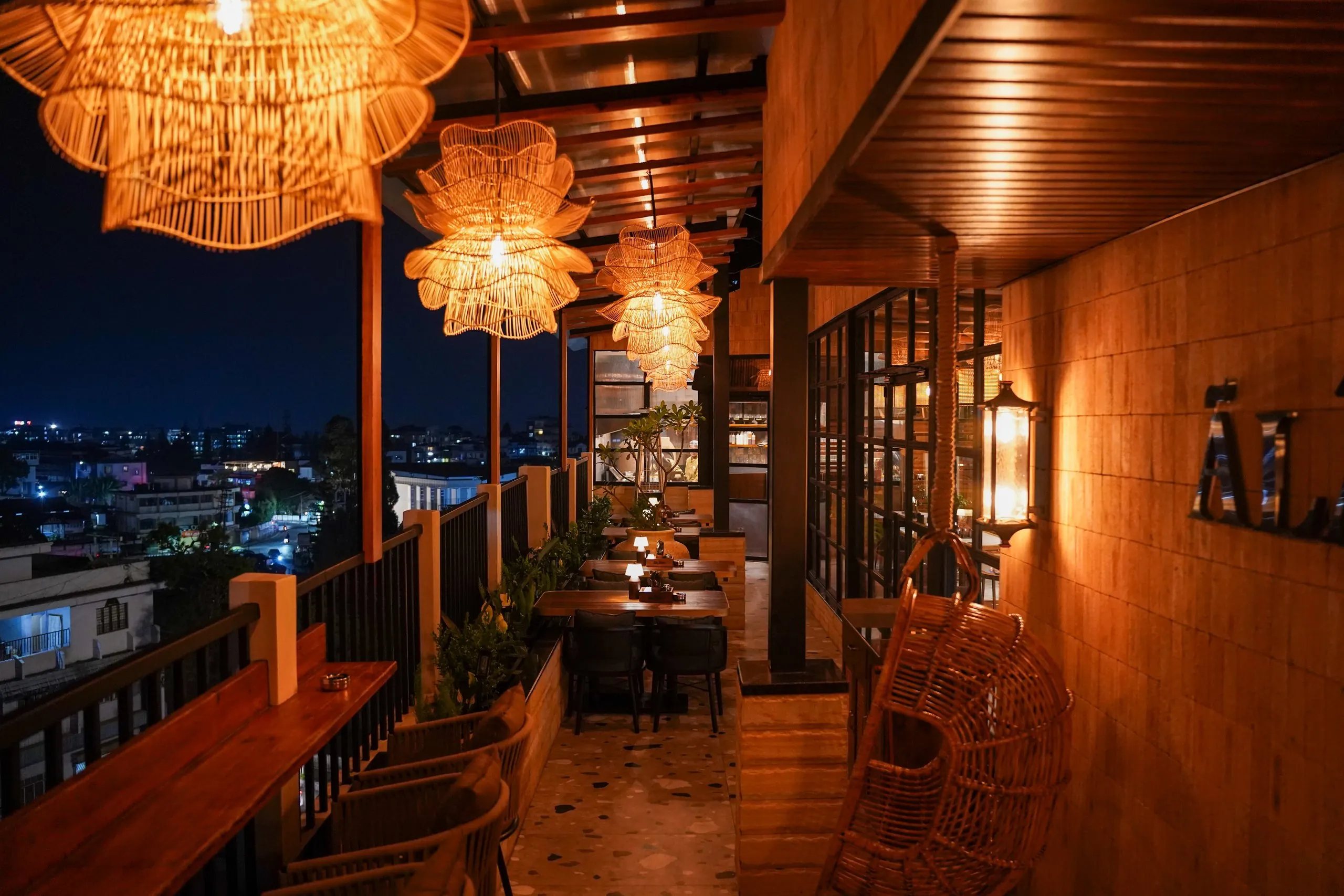

A restaurant pays rent for every hour of the day and earns in only some of them. Most concepts have a natural rhythm. Cafés tend to be strongest through breakfast, lunch and the afternoon, then taper into the evening. Cocktail bars face the reverse pattern: quiet through the day, busy after dark. Each, on its own, leaves expensive space underused for part of the day.
Designing around dayparts means planning one venue to trade well across several of those periods, each with its own guest, order and reason to visit. Done well, it lets the same site, kitchen and team earn across more of the day. Done badly, it produces a venue that always seems to belong to some other hour.
Uptown Escape in Guwahati was built on this idea. BDS developed it as a full A-to-Z consultancy, and it opened in 2019. The starting point was a commercial question: why a café should lose relevance at night while a cocktail bar sits underused through the day. The two demand curves are complementary, and the concept that followed fits in a line: cafe by day, cocktail bar by night.
One business across the day
The easy versions of this idea are a café that happens to serve cocktails, or a bar that opens its doors at lunch. Guests tend to see through both. A morning guest in a room that is plainly a bar waiting for night, or an evening guest in a café with the lights turned down, can tell the venue was not really planned for them.
The aim at Uptown was one coherent hospitality business that changes mood, use and spend over the course of the day, rather than two concepts sharing an address. That requires every part of the venue, from the menu and the bar to the lighting and the team, to be planned for both modes before anything is built.
Start with the occasions, then the menu
A useful first step is to map the day as a series of occasions rather than opening hours. Each has a different guest, a different length of stay and a different spend.
- Morning: coffee, breakfast and quick visits, often alone or in pairs.
- Midday: lunch against the clock, where speed matters more than ceremony.
- Afternoon: long stays over coffee and something sweet, with meetings and laptops.
- Early evening: the changeover, when the room has to start feeling like night.
- Late evening: cocktails, sharing plates and groups who stay.
Each occasion asks something different of the menu, and the menu is where daypart venues most often overreach. Two complete menus mean two sets of prep, two inventories and a kitchen trying to be two kitchens. The more workable approach is to plan the food across the day from one shared pantry: ingredients and preparations that appear on a breakfast plate in the morning and in a bar snack late at night, dishes that cross between periods, and an evening menu written to sit alongside cocktails. This is where food and beverage planning and the kitchen have to be decided together.
The kitchen follows from that. A breakfast service and a late bar menu need different equipment and different stations, and the line has to be laid out so that one can wind down while the other comes up. The bar is the harder question. A café bar is built around the coffee machine, the grinder and a display for bakes. A cocktail bar needs ice, glassware storage, a back bar, speed and room for more than one bartender at the peak. Deciding early whether one bar does both jobs, or whether coffee moves to its own station at night, changes the layout, the plumbing and the staffing.
A room that changes with the light
The design brief for a daypart venue is unusual: the same room has to be right at noon and at midnight. At Uptown, the venue needed to feel approachable and comfortable in daylight and warmer and more intimate after dark, without splitting into two identities. The answer to that kind of brief is a single environment with enough visual depth to carry different occasions.
On any daypart project, a handful of decisions do most of the work. Lighting is planned in layers and on separate circuits, so the room can move from bright and even to low and warm without anyone rearranging furniture. Window treatments decide how much daylight comes in, and whether the evening room feels enclosed or exposed. Materials are chosen to look fresh in daylight and warm under low light, which rules out finishes that only work in one. Seating has to suit a laptop in the afternoon and a group of friends late in the evening, which usually means a mix of table sizes and heights instead of one type repeated. Music and acoustics change too, because what suits a working afternoon will not carry a busy bar.
The changeover is an operation
After two decades in hospitality, I would call the hour between modes the most fragile moment in a daypart venue. The menu changes, the lights change, the music changes, tables are reset, the bar is set up for the evening and, often, the shift changes too. If that handover is not planned, guests see a venue in the middle of rearranging itself, and the evening trade starts late.
Staffing needs the same planning. The skills of a morning team and a night team overlap less than they seem to: a barista and a bartender are different hires, and a lunch service is paced differently from a late bar. Overlapping shifts at the changeover, a named owner for each step of it and training that covers both modes are what let one team deliver one standard of service. The bar licence and its permitted hours should also be confirmed before the concept is fixed, because they decide how long the evening can run.
When dayparts are the wrong answer
Not every site suits all-day trading. A location with strong office footfall at lunch and little after dark, or a nightlife street that stays empty until evening, may be better served by doing one daypart well and closing for the rest. Every added period brings more staff hours, more stock, more cleaning and more complexity. Before committing, an owner should be confident that the extra trade will cover that cost, and that the site gives guests a genuine reason to come at each time of day.
Where the site does support it, the reward is relevance: more occasions on which the venue is the obvious choice. A wider range can do some of the same work as longer hours. When BDS repositioned Nuts & Brew, an established Guwahati microbrewery, in 2025, the beer programme grew from four beers on tap to eight. More taps make room for rotation, tastings and flights, and give regulars another reason to come back.
If you are weighing up an all-day concept, or running a venue that trades well for only part of the day, we would be glad to start a conversation.